Autonomy
Ability to pilot a drone using vision and telemetry, without relying only on predefined paths or scripted behavior.
A TELLgen AI project
Autonomous Drone Pilot is an AI-based piloting technology developed by TELLgen Aerial Intelligence Technologies to research and develop autonomous flight intelligence for drones and UAVs.
Concept
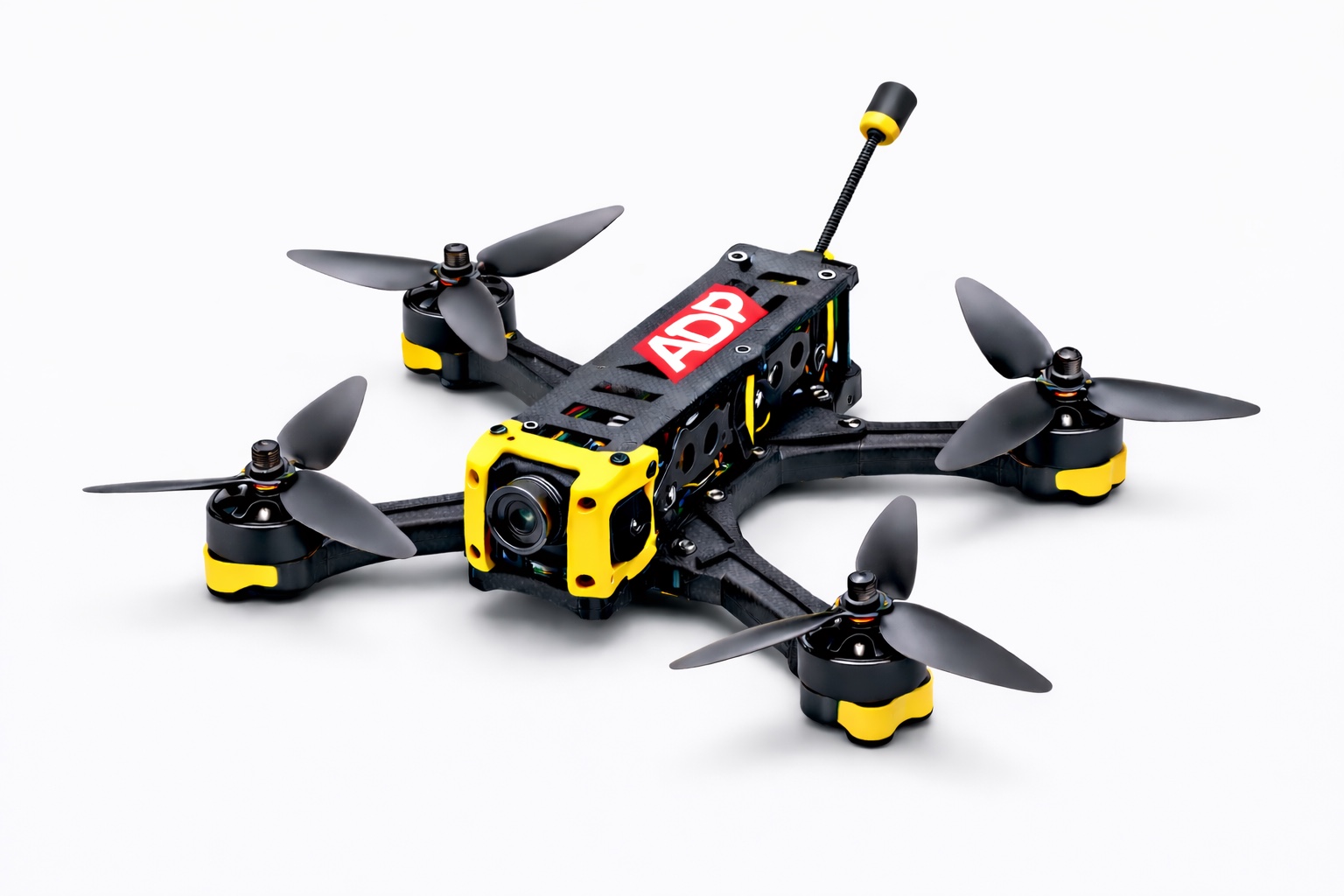
ADP is not designed as a traditional waypoint autopilot. It focuses on learned piloting competence: the ability to interpret visual input, telemetry, spatial orientation and flight context, then transform that understanding into adaptive control behavior in real time under human supervision.
The project studies how a drone piloting agent can be trained through simulation, real flight experience and structured flight datasets to develop practical aerial capability across different environments, flight styles and operational conditions while preserving traceability, safety boundaries and regulatory compliance.
Core properties
The following properties summarize the capability goals of the Autonomous Drone Pilot project.
Ability to pilot a drone using vision and telemetry, without relying only on predefined paths or scripted behavior.
Capability to operate in changing environments by reacting to visual cues, motion and flight dynamics.
Strict control boundaries, fallback behavior and complete logging to support accountability and risk reduction.
Architecture prepared for regulatory, ethical and operational constraints in aviation and AI governance contexts.
Structured flight data and action records for auditing, validation, analysis and technical review.
A modular development path from core piloting to regulated autonomy and future mission intelligence.
Framework
ADP is built around a complete development framework: flight data creation, dataset preparation, agent training, validation, safety analysis and supervised integration. The purpose is to create aerial agents that can learn operational behavior, not only execute fixed instructions.
Simulation, controlled flights and pilot demonstrations
Vision, telemetry, control signals and operational context
Development of perception, situational awareness and piloting behavior
Testing, audit, safety review and performance evaluation
Piloting intelligence
ADP represents aerial autonomy as embodied intelligence. The agent is considered as a single operational entity with a real embodiment and a unified cognitive core. It must perceive through its sensors, understand its own motion in a fast-changing environment, determine appropriate actions, and operate continuously in a mission-oriented manner while remaining supervised and bounded.
Development path
The project began in 2025 from the observation of drone piloting as a learned cognitive and operational capability, combining FPV practice, AI research and aerial robotics engineering.
Research focused on connecting perception, state understanding and piloting decisions into a coherent aerial agent suitable for supervised operation.
ADP uses structured flight data from simulations and real flights, including visuals, telemetry, flight control and mission-specific information.
Training aims to develop capabilities such as lift-off, turns, speed changes, obstacle avoidance, gate navigation, target approach and landing.
Dedicated environments support training, optimization, conformity testing and the progressive evolution of specific aerial abilities.
Safety and governance
ADP is developed with safety, traceability and human authority as core requirements. Flight intelligence must be observable, testable, bounded and suitable for review before any real operational use.
Autonomous operation must remain subject to human oversight and defined fallback mechanisms.
Flight data and decisions are structured to support technical review and validation.
The framework is oriented toward aviation safety, AI governance and responsible development.
Product line
The ADP product line is the first adaptation of TELLgen’s core research and development in Physical AI agents, autonomous piloting, simulation, structured datasets, validation and supervised aerial autonomy. This page presents the public product concept and positioning. Detailed deployment models will be described separately.
Next-generation ADP adaptations for autonomous UAV pilot agents targeting fixed-wing (ADP-FW) and high-speed (ADP-HS) aerial systems are currently in research and design phase.
Contact
For research collaboration, pilot projects, demonstrations or technical discussions, contact TELLgen.